


Some partnerships begin with a shared conviction before they begin with a collaboration. RANA and Apurva.ai are grounded in the shared belief that communities are not subjects of change, but their authors.
Meet RANA (Resilience Action Network Africa), a civil society platform focused on epidemic preparedness, community resilience, and health security advocacy across African countries.
In conversation with Anthony Ombara, Senior Advisor, Kenya, we traced the what, why, and how of their journey with Apurva, from placing communities at the centre to closing the loop, and reimagining systems-level change across the countries they work in.
The RANA and Apurva.ai Journey
One of RANA’s areas of work revolves around bringing together lived experiences from focus group discussions, building an evidence-based systems-level transformation and a deeper understanding of resilience across Africa.
Their ‘what’ was to go beyond summarising data and towards identifying patterns, contradictions, systems-level issues and advocacy priorities across multiple resilience themes. Preparedness and resilience are two important terms here. They are multidimensional, impacted by a community’s physical, social, political, historical and financial facets. With multiple layers to gauge, Apurva helps to understand them, surface patterns, and identify gaps. This is very relevant to RANA’s work, which greatly changes the way people live, enabling them to be more resilient.
With Apurva LENS, they generated summaries faster, surfaced emerging themes and drafted analytical outputs across Kenya, Sierra Leone, South Africa and Uganda. They brought together knowledge sources in multiple languages like Afrikaana, English, Luganda, Sierra Leonean Krio, Swahili and Zulu.
They dug deeper into the data collected using multiple prompts, examining it from different angles. They observed that LENS worked best when combined with human contextual judgement: AI helps to organise and accelerate analysis, whereas the human, backed with contextual knowledge, interprets. This resulted in advocacy products like policy briefs and talking points that resonated with various stakeholders: communities, governments and funders
Communities in the centre
RANA’s work is built on the foundation of community knowledge, and aligned with Apurva’s community-centric approach. Grounded in the belief that communities are closest to realities where resilience is lived, Mr Ombara said, “They are the ones who are living the realities of climate change.” He explained that this showcases how communities are experiencing different phenomena, especially risks and shocks, and how resilient they are. And this helps to design their work.
“Our theory of change is grounded in the communities,” Mr Ombara stated. This is rooted in the belief that if communities can start crafting, engaging and coming up with modalities on how to respond to some of the issues, we’ll see more changes happening at the level of communities instead of having top-down policy engagement. At RANA, it is all about collective ownership. This translates to policies that respond to issues grounded in the community’s realities, where it is held by all stakeholders involved.
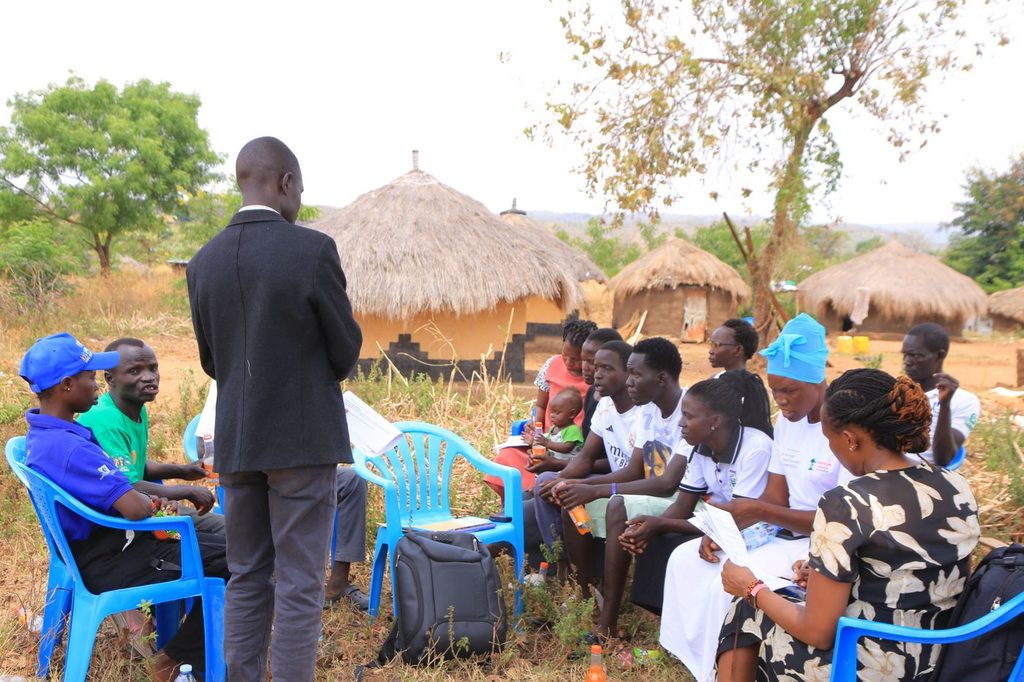
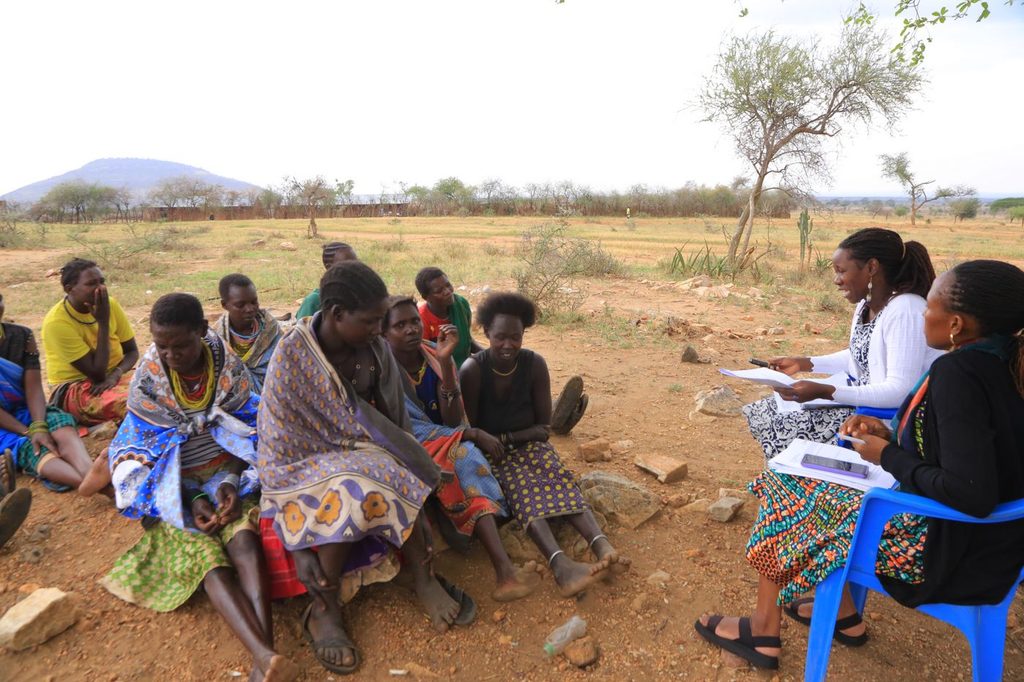
Community Dialogues, Uganda
This helped to sharpen the theory of change, which was grounded in community voices and stakeholders’ reflections, not in assumptions. This offered a window to sharpen their ‘how’ by identifying the most urgent barriers to resilience faced by communities and prioritising advocacy based on recurring concerns across communities and countries. On how Apurva LENS helps in grounding their theory of change to communities better, Mr Ombara said, “Improve accountability. If the platform helps preserve community voice and trace findings back to the source, RANA can use the evidence to engage policymakers, donors, and institutions more credibly.”
Closing the Loop
RANA’s approach of closing the loop with communities occurs on two fronts: 1, validating data and insights gathered with community members; 2, designing theory of change, policies and action plans from community voices.
Here is a snippet from the interview where Mr Ombara explains the why behind validating with communities and closing the loop.
In Action: From Dialogue to Policy
In June 2026, the Kenya budget cycle began with the reading of the budget statement. RANA had community members analysing the budget and looking for gaps. They were especially on the lookout for gaps in resources to respond to epidemics and resilience issues that were previously identified. After the release of the budget statement, discussions are opened for public engagement and participation before being developed into action plans and implementing the budget.
“Communities are now engaging with the statement and giving proposals on how to engage moving forward in terms of that budget,” Mr Ombara added.
A connected system
An intentional move towards a systems view, RANA is moving away from siloed engagement. “We realise that most of the shocks and most of the resilience issues are interconnected, so they require intersector engagement.” Community voices needed to be brought together, connected to broader structural issues to understand deeper systems issues of resilience. Community voices cannot be treated as isolated testimonies.
When asked what role RANA sees AI playing in having a systems view, Mr Ombara highlighted that it could draw multi-sectoral synthesis during system-based engagements, where system drivers and interconnectedness are highlighted. Here, AI complements human thinking by organising and synthesising complex data, leading to efficient analysis across geographies.
At the same time, RANA emphasises how each of the countries they work in has its own context, histories, issues and solutions. Armed with different perspectives and voices, RANA is looking at each country to offer voices and knowledge that is specific to their context and priorities. The aim is for it to add to RANA’s knowledge hub, where cross-learning as an approach supports comparison without flattening context. Mr Ombara elaborates on how RANA looks at cross-learning and bringing together community voices for a deeper understanding of the system.
On this note of shifting to a systems view, we concluded the interview. Looking ahead, RANA aspires to have a system that is prepared to respond to shocks before they occur. It is exciting to be a part of this grand journey, where RANA is looking forward to expanding the use of Apurva to other countries they work with to understand policy and implementation gaps, thereby building stronger advocacy and engagement.