
Founder’s Note

Across our work with climate, health, livelihoods, financial inclusion, and other pressing challenges, we have come to recognize a humbling truth: complexity cannot be solved; it can only be navigated. 

Most of the problems facing our societies today are not static puzzles. They are deep, rooted, and highly interconnected systems—constantly evolving, often accelerating. Their impacts unfold exponentially, but unevenly. And it is always the communities closest to the frontline who feel these shifts most viscerally. 

A smallholder farmer does not experience climate change as an abstract trend line. A shift in rainfall or temperature reshapes everything—cropping cycles, growth, yield, price, and ultimately, survival. Their exposure is immediate and existential, while the resources to act are distant, centralized, or fragmented. 

The Double Exponential Gap 

In observing these systems, we see a phenomenon we call the Double Exponential Gap. 

The first exponential is the accelerating nature of the problem itself—the way climate volatility, health crises, or livelihood shocks compound over time. 

The second exponential is the widening distance from resources. A few actors hold vast institutional capability, while millions navigating these crises have very little. This creates what we call the C-Curve: a steep, unequal distribution where those with the deepest context lack resources, and those with resources lack context. 

This split produces a profound Collective Wisdom Gap—both horizontal and vertical. Horizontally, local insights rarely flow across communities facing similar struggles. Vertically, the “top” lacks granular sensing, and the “bottom” lacks access to institutional knowledge. 

When the problems of our time grow exponentially, wisdom cannot remain fragmented. 

From Uniform to Unified 

For too long, “scale” has meant a top-down template—a uniform solution rolled out everywhere. While sometimes necessary, this approach struggles in hyper-local contexts where nuance determines success. 

At Apurva, we are asking a different question:
Can scale emerge from the bottom up? 

What if scale was not imposed, but grown?
What if communities were the first mile of insight, not the last mile of implementation? What if many local, context-rich responses could be connected so that a unified pattern emerges—one that is not uniform, but coherent? 

This shift—from Uniform Scale to Unified Scale—requires a renewed commitment to three pillars: 

Listen:
To truly hear communities, NGOs, field teams, and frontline actors—not as data points, but as partners in sensing complexity. 


Learn:
To enable circular flows of wisdom—peer-to-peer learning, bottom-up insight for funders, and the translation of institutional knowledge into contextual practice. 


Act:
To enable the ecosystem to respond collectively, with interventions that are as local as the problem they seek to address and as connected as the systems they inhabit. 

The Promise of Apurva 

Apurva was built as an architecture for this kind of response. 

A suite of product building blocks powered by exponential technologies. Platforms that strengthen interactions and network effects. Protocols that enable shared discovery, interconnected learning, and emergent intelligence. 

In other words: tools designed not to simplify complexity, but to work with it, mirroring the systems they serve. 

We believe the future of solving complex problems lies in unlocking local collective wisdom and enabling ecosystems to act together—rooted in context, connected at scale. 

We invite change-makers, funders, and institutions to join us in building this unified, bottom-up architecture of response. Because the challenges ahead are too complex for any one actor—and too urgent for us to remain disconnected. 

— Anand 

Share this post

Curating collective wisdom from the farms of Tamil Nadu on agricultural innovations

The power of voice, the ability to represent one’s perceptions and knowledge, has constantly shaped the world around us. And we saw that unfolding when listening to the hundreds of farmer’s voices responding to queries.

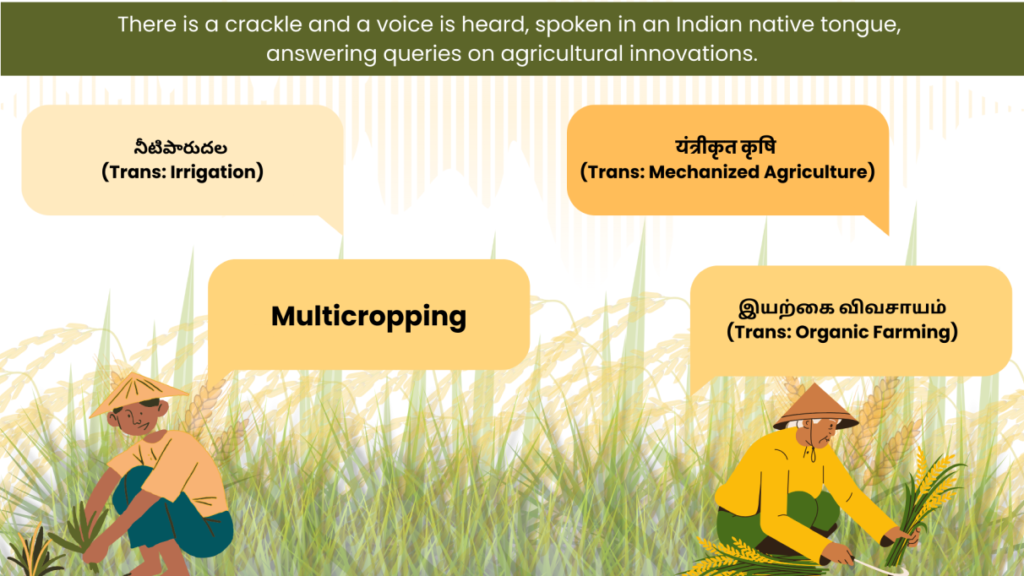
The Ministry of Agriculture and Farmers Welfare, Government of India, with the Voice of Community, has created a repository of wisdom on agricultural innovations from the state of Tamil Nadu from more than 1500 farmers. The audio recordings of these farmers detail their experiences and expertise of having worked on the field and the various creative solutions they have implemented. These can be as simple as alternating elaborate drip irrigation systems with empty IV bottles, timed to slowly water the crops. There are also stories of individuals inspiring their villages and beyond to take up healthier agricultural practices to meet their requirements with the resources available. One of the favourite aspects of listening to farmers is the lack of middle persons. We are free to listen to the audio, which Apurva.ai translates to our preferred language and establish our own understandings for our queries.   
What is the Voice of Community?
A part of Apurva.ai’s product line, the VoC opens the door to include knowledge directly from the community through audio recordings. These sound files are ingested into Apurva.ai, adding on to the ever growing digital brain, providing answers from the unseen viewpoints of local practices and ideologies, which are mostly difficult to capture.

Why Voice?
Sound bytes are not only easy to record and procure the community’s knowledge and experience, but they also bring a sense of authenticity to the knowledge curated. This builds a sense of trust and reliability for the query seekers. And most importantly, they shine light on localised solutions of global problems with local resources and expertise, which can be adopted and tweaked across regions, cultures and problems. 

How? 
Audio files offer the flexibility and ease to record knowledge from people across the vertical and horizontal axis. Aided with audio recording softwares, answers from interviews are taped and uploaded to the digital brain. Apurva.ai synthesises, analyses and reimagines with the amassed data. 

Farmers form a strong and knowledgeable community, where their expertise of working on the field are powerful data sets that can lead to further innovations in the sector. Alongside farmers, various actors like startups, self help groups, cooperatives and agripreneurs are a part of the agricultural sector, adding and contributing to the community’s knowledge source. 
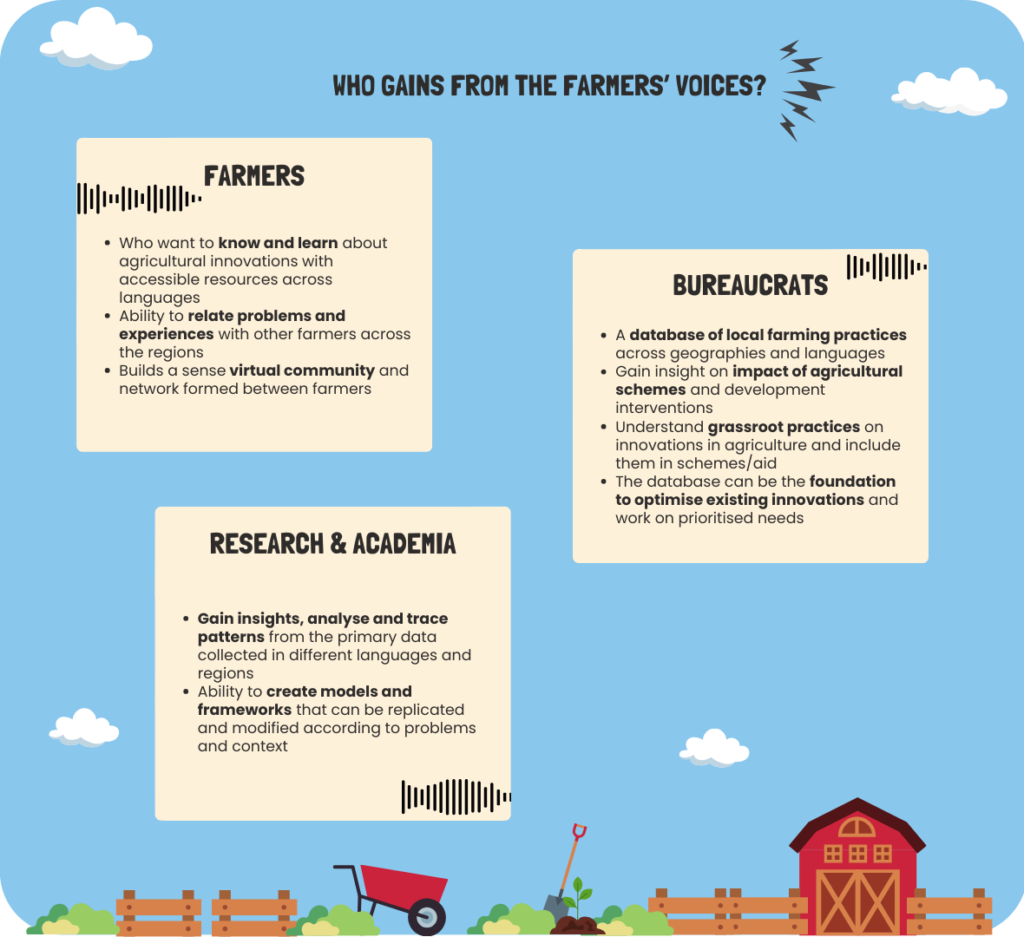
Listen, and seek your answers. This is the vision behind Voice of Community. And the Voice of Community has enabled the experience and expertise of farmers to weigh in. The voice of farmers is not merely a statement emphasising a space where farmers’ views are represented for us anymore. The very definition of voice is being changed with Apurva.ai, where one can listen to the crackling audios answering queries, bringing forth the actual voice of farmers from the field. And that was and still is the aha moment as we explore topics of agriculture and innovations with the Ministry of Agriculture and Farmers Welfare, Government of India. 

Continue Your Journey

Discover more insights and tools that empower communities to drive meaningful change.

Previous Next