
Founder’s Note

Across our work with climate, health, livelihoods, financial inclusion, and other pressing challenges, we have come to recognize a humbling truth: complexity cannot be solved; it can only be navigated. 

Most of the problems facing our societies today are not static puzzles. They are deep, rooted, and highly interconnected systems—constantly evolving, often accelerating. Their impacts unfold exponentially, but unevenly. And it is always the communities closest to the frontline who feel these shifts most viscerally. 

A smallholder farmer does not experience climate change as an abstract trend line. A shift in rainfall or temperature reshapes everything—cropping cycles, growth, yield, price, and ultimately, survival. Their exposure is immediate and existential, while the resources to act are distant, centralized, or fragmented. 

The Double Exponential Gap 

In observing these systems, we see a phenomenon we call the Double Exponential Gap. 

The first exponential is the accelerating nature of the problem itself—the way climate volatility, health crises, or livelihood shocks compound over time. 

The second exponential is the widening distance from resources. A few actors hold vast institutional capability, while millions navigating these crises have very little. This creates what we call the C-Curve: a steep, unequal distribution where those with the deepest context lack resources, and those with resources lack context. 

This split produces a profound Collective Wisdom Gap—both horizontal and vertical. Horizontally, local insights rarely flow across communities facing similar struggles. Vertically, the “top” lacks granular sensing, and the “bottom” lacks access to institutional knowledge. 

When the problems of our time grow exponentially, wisdom cannot remain fragmented. 

From Uniform to Unified 

For too long, “scale” has meant a top-down template—a uniform solution rolled out everywhere. While sometimes necessary, this approach struggles in hyper-local contexts where nuance determines success. 

At Apurva, we are asking a different question:
Can scale emerge from the bottom up? 

What if scale was not imposed, but grown?
What if communities were the first mile of insight, not the last mile of implementation? What if many local, context-rich responses could be connected so that a unified pattern emerges—one that is not uniform, but coherent? 

This shift—from Uniform Scale to Unified Scale—requires a renewed commitment to three pillars: 

Listen:
To truly hear communities, NGOs, field teams, and frontline actors—not as data points, but as partners in sensing complexity. 


Learn:
To enable circular flows of wisdom—peer-to-peer learning, bottom-up insight for funders, and the translation of institutional knowledge into contextual practice. 


Act:
To enable the ecosystem to respond collectively, with interventions that are as local as the problem they seek to address and as connected as the systems they inhabit. 

The Promise of Apurva 

Apurva was built as an architecture for this kind of response. 

A suite of product building blocks powered by exponential technologies. Platforms that strengthen interactions and network effects. Protocols that enable shared discovery, interconnected learning, and emergent intelligence. 

In other words: tools designed not to simplify complexity, but to work with it, mirroring the systems they serve. 

We believe the future of solving complex problems lies in unlocking local collective wisdom and enabling ecosystems to act together—rooted in context, connected at scale. 

We invite change-makers, funders, and institutions to join us in building this unified, bottom-up architecture of response. Because the challenges ahead are too complex for any one actor—and too urgent for us to remain disconnected. 

— Anand 

Share this post

As I eased into my seat on a recent flight from Bangalore to Hyderabad, I couldn’t help but overhear an interesting discussion between my two fellow passengers regarding ChatGPT. Despite their divergent viewpoints, they concurred on ChatGPT’s overarching utility and how it has completely changed the way they accessed knowledge. Preferring not to intervene, I took on the role of a silent observer, entranced by their dialogue.

This, however, prompted me to ponder about #generativeai , the revolutionary technology that drives ChatGPT, BARD, and numerous other products and platforms, and the level of pervasiveness it has brought about. Many experts believe that, if appropriately designed and regulated, this technology has the potential to be transformational, on par with the likes of Electricity and the Internet. But what sets it apart? Despite AI having been around for decades, steadily evolving, what caused the sudden exponential upswing in the last few years?

While the cumulative impact of advancements has certainly contributed, I contend that the more influential factor has been the introduction of a novel architecture model known as “Transformers”. This breakthrough has endowed Generative AI with the capability to assimilate information at an unparalleled magnitude and velocity.

Powered by a foundational Neural Network, these models now have the potential to establish a “Network of Knowledge” on an internet- scale, transforming the way we access and process information.

But how does all of this relate to #changeleaders?

Societal problems can often seem like a tangled knot, with multiple stakeholders, perspectives, and causes making it arduous to uncover a solution. To tackle these intricate problems, several valuable Systems Change frameworks have arisen. One shared trait among these approaches is the imperative to perceive the system holistically, as a web of interconnected and interacting entities striving towards a shared objective.

Of course, putting this idea into practice is easier said than done. It requires collaboration across diverse minds, a willingness to embrace complexity, and the ability to harness the “Knowledge of their Network” and transform it into actionable insights and wisdom.

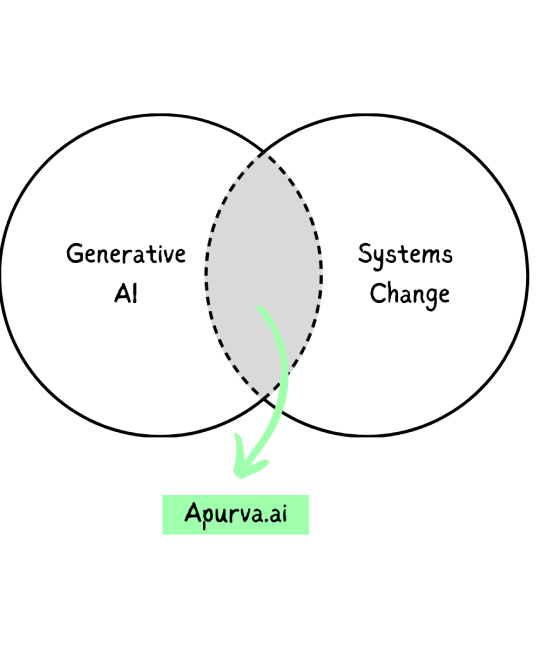
Generative technologies that enable a “Network of Knowledge” can assist Change Leaders in their endeavor to harness the “Knowledge of their Network”.

This inspired us to develop Apurva.ai, an open innovation platform for Change Leaders to harness the collective wisdom of their networks.
Although exponential technologies offer great potential for solving societal problems, one must exercise prudence when designing such systems to make sure they are enabling (not controlling) and help restore the agency of the overall system.

At Apurva.ai, we strive to address critical questions such as how to design systems for emergence, make them inclusive, govern them, and ensure their trustworthiness.

Join us in this exploration. Together, we can create a more equitable and sustainable future.

Visit us @ Apurva.ai

Continue Your Journey

Discover more insights and tools that empower communities to drive meaningful change.

Next